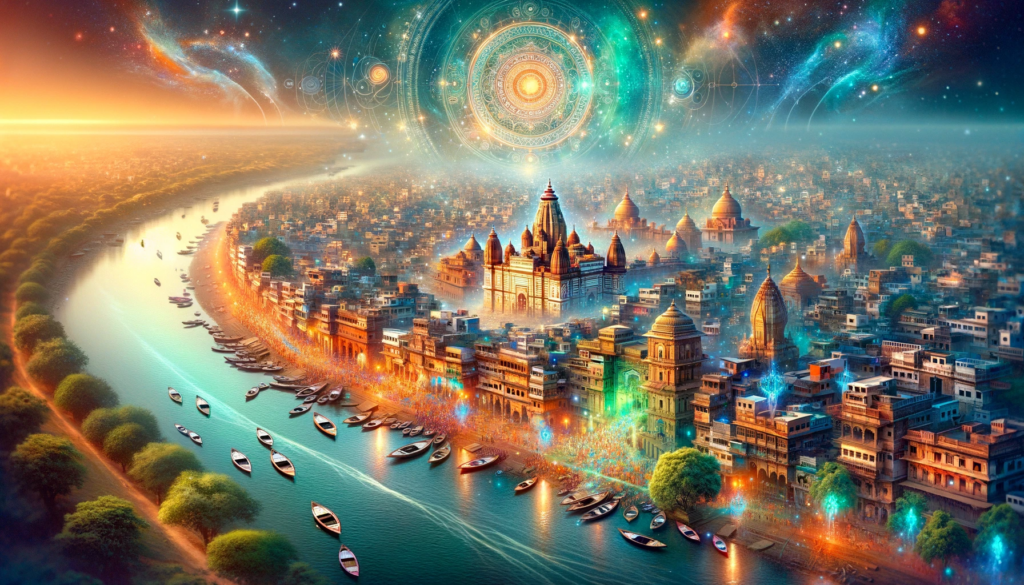
Kashi (Varanasi) is not just a city built on land. It is a city imagined, lived, and walked as a cosmos. Its streets, temples, rivers, rituals, and calendar together form a sacred system that links space, time, body, and liberation.
This understanding comes from ancient texts like the Kāśī-khaṇḍa (Skanda Purāṇa) and is clarified for modern readers by scholars such as Rana P. B. Singh.
1. Why Kashi Is Called a Cosmic City
In Indian thought, the universe is not random. It has order (ṛta / ऋत). Sacred cities mirror this order on earth.
Kashi is believed to exist outside ordinary time. Myth says Shiva whispers the tāraka mantra here at death, granting liberation. Symbolically, this means Kashi is imagined as a threshold between worlds — life and death, form and formlessness.
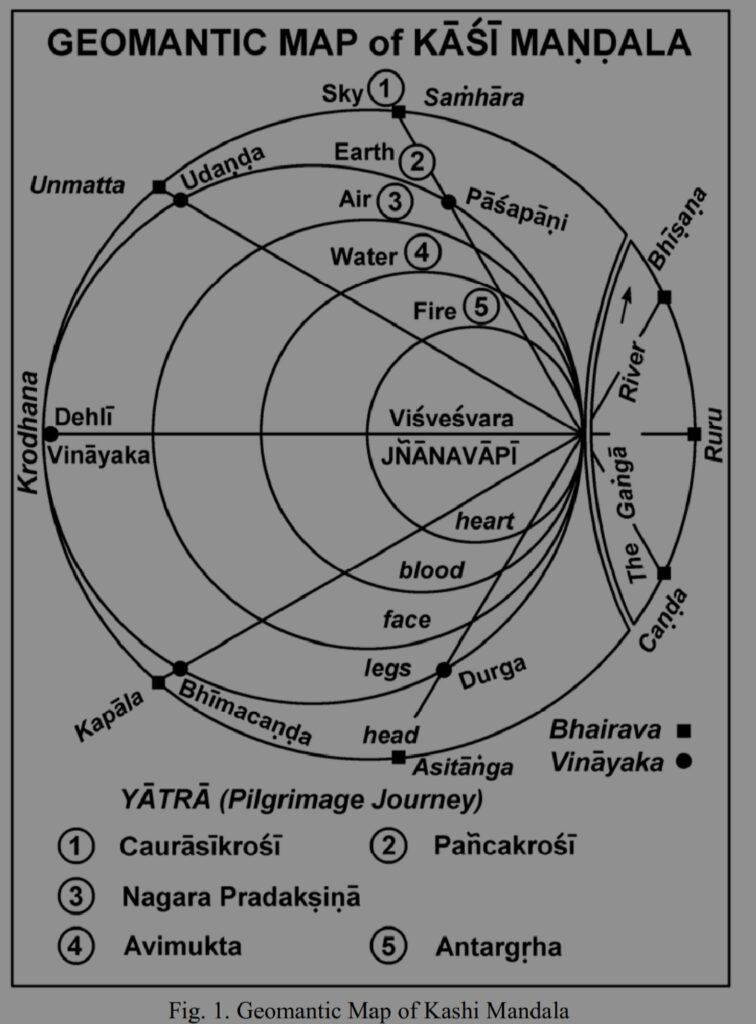
A mandala is a sacred diagram used in yoga, tantra, and temple design. Rana P. B. Singh shows that Kashi functions as a living mandala.
Key ideas made simple:
The center is Kashi Vishwanath (Shiva as pure consciousness)
The circles are pilgrimage routes (yatras)
The edges mark transition from sacred to worldly space
Major Mandalas of Kashi
Avimukta Kshetra – the never-abandoned inner core
Nagar Pradakshina – city circumambulation
Panchkroshi Mandala – 5-day, ~80 km cosmic walk
Walking these routes is like moving through a spiritual diagram with your body.
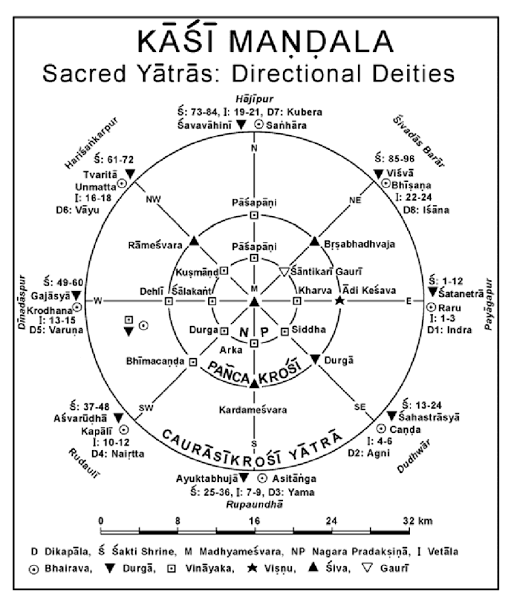
3. Yantra: Invisible Geometry Beneath the City
Map by P.B. Rana Singh
If mandala is the map, yantra is the engine.
Kashi is associated with the Shiva–Shakti principle:
Shiva = stillness, axis, cremation grounds
Shakti = movement, river, fertility, festivals
The Ganga curves northward here — unique in India — symbolizing the upward flow of consciousness. Cremation grounds face the rising sun, reversing normal fear of death.
This is not accident. It reflects a tantric worldview, where liberation comes by confronting impermanence.
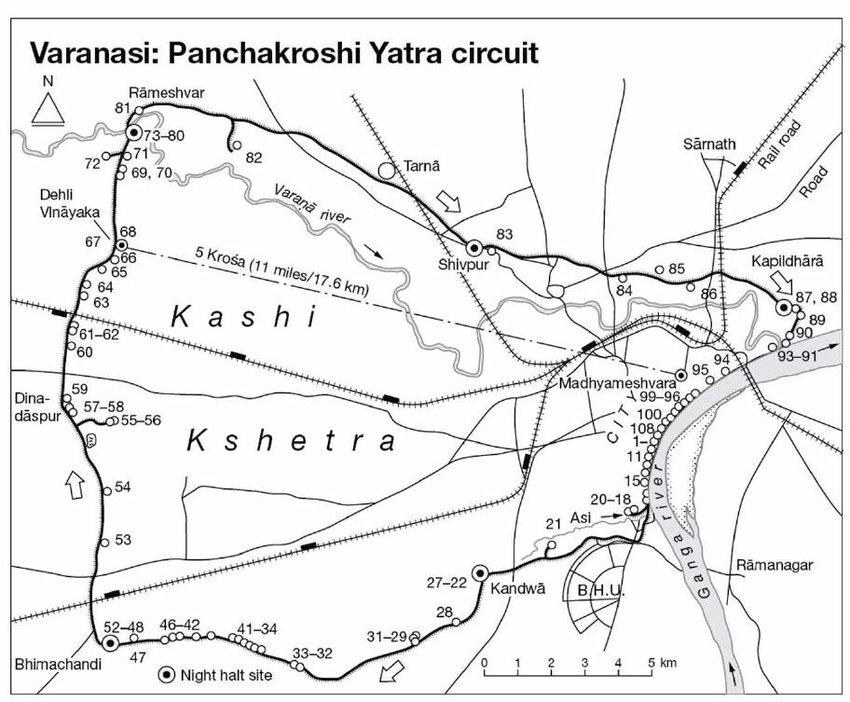
4. Sacred Numbers: 108 and Beyond
Map by P.B. Rana Singh
Numbers repeat across Kashi — not superstition, but symbolic math.
Why 108 matters
Distance between Earth and Sun ≈ 108× Sun’s diameter
Distance between Earth and Moon ≈ 108× Moon’s diameter
108 beads in a japa mala
108 names of Shiva
In Kashi:
Clusters of temples mirror these counts
Ritual repetitions follow 108 cycles
108 shrines along the Panchkrosi Yatra.
Time (tithi, nakshatra) aligns ritual schedules
The city becomes a calculator of the cosmos.
5. Astrology and Time in Kashi
Kashi does not treat time as linear.
Days follow lunar rhythms
Festivals align with nakshatras
Death rituals consider planetary positions
Important festivals:
Mahashivratri – cosmic union
Dev Deepawali – gods descend to the ghats
Makar Sankranti – solar transition
Time here is experienced, not just measured.
6. Festivals: When the Mandala Comes Alive
During festivals, the city transforms:
Streets become ritual corridors
Ghats become celestial stages
Homes become shrines
The entire population participates. The mandala activates.